

Nearly every first-time landlord leaves money on the table during tax season. You are busy finding tenants, fixing leaky sinks, and figuring out leases, so the tax code usually comes last. The result is that you pay more tax than you have to, often by missing simple deductions that the IRS already allows you to take.
This guide walks you through those easy‑to‑miss rental property tax deductions so you can keep more of your cash. You will see how repairs, management fees, interest, depreciation, and travel all show up on your return, and how tools like tax season features inside Rentastic can make the whole process much easier to manage.
Before you apply any of this, talk with a qualified tax professional. This guide is here to make the rules clearer so you can ask better questions and spot more savings.
If you think about taxes only in March or April, you will miss deductions. The best way to win tax season is to treat it like a year‑round habit, not a once a year scramble.
You want three things in place as early as possible:
When you connect your rental bank and credit card accounts to a tool like Rentastic, it automatically pulls in transactions and organizes them into a Profit & Loss statement. That makes it much easier at tax season to see where your money went and which line items belong on Schedule E.
With your base in place, you can focus on the specific deductions that first‑time landlords commonly miss.
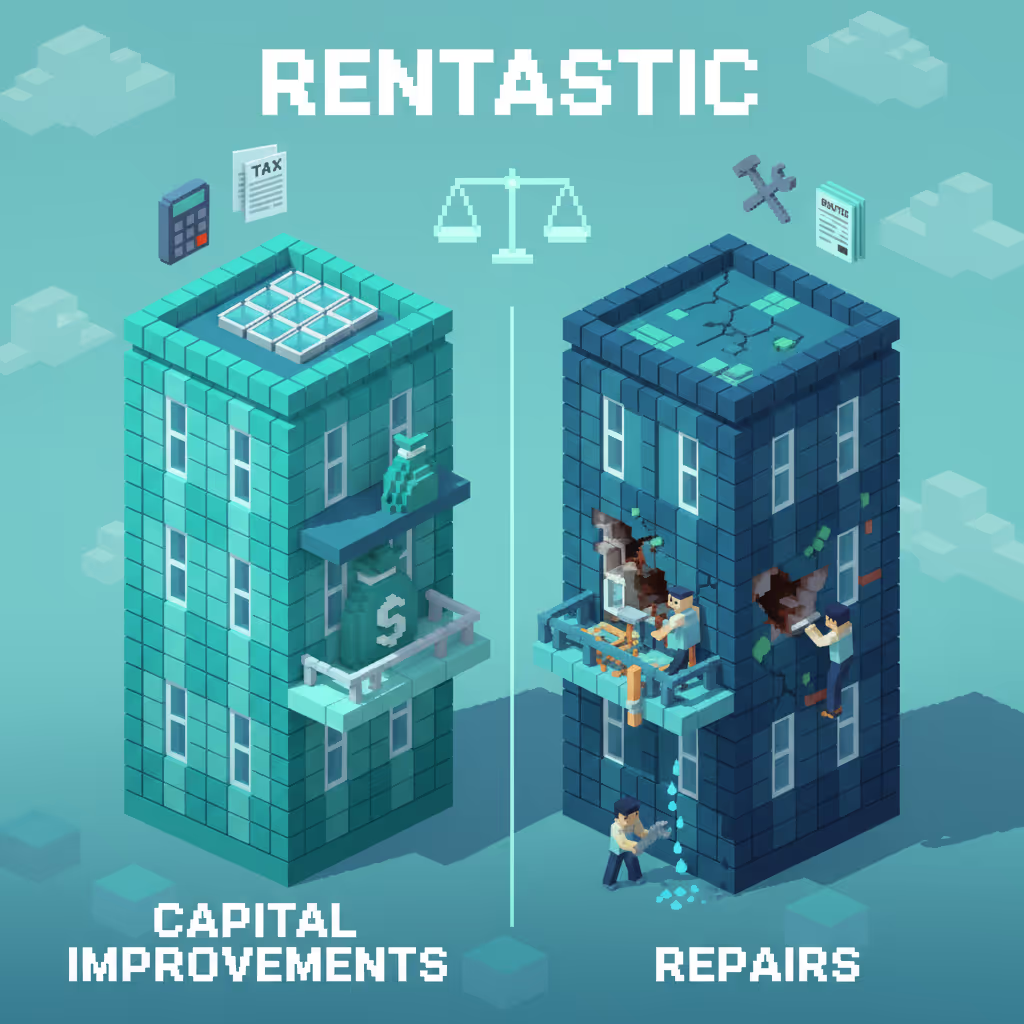
Your property always needs something. A faucet drips, a tenant breaks a window, a roof finally gives up after a storm. A lot of first‑time landlords do not realize that the IRS treats these costs differently depending on whether they are repairs or improvements.
Repairs keep your rental in working condition without adding significant value or extending its life. These are generally fully deductible in the year you pay for them, which gives you a nice tax benefit right away.
Common examples include:
According to current IRS rules, repairs on rental properties are usually deductible in the year incurred, which means they reduce your taxable rental income for that year.
Improvements are bigger projects that add value, extend the useful life of the property, or adapt it to a new use. You do not deduct these in one shot. The IRS requires you to capitalize them and depreciate the cost over time, generally 27.5 years for residential rental property and 39 years for commercial property.
Examples of improvements:
The distinction really matters. If you treat an improvement as a repair, you may face issues in an audit. If you treat a repair as an improvement, you delay a deduction you could have used right away.
Tracking these costs throughout the year in software makes it much easier to separate routine repairs from capital improvements when tax season arrives.
If you are a first‑time landlord, you may hire help quickly. Maybe you use a property manager to handle tenant screening and maintenance calls, or a leasing agent to fill vacancies. Those fees are often some of the biggest deductions new landlords forget to take.
The IRS treats management fees as ordinary and necessary expenses for your rental activity. That means they are fully deductible in the year you pay them and belong under “Expenses” on Schedule E.
Deductible fees can include:
The key is documentation. Save management contracts, monthly statements, and year‑end summaries. If you use Rentastic to pull in your bank activity, you can tag every payment to your manager so that when tax season hits, those expenses are already grouped and ready to enter.
You can usually deduct other professional fees tied to your rentals as well, such as:
Again, the secret is to separate personal and rental costs and to track rental‑only payments through a dedicated account whenever possible.
If you used a mortgage or loan to buy or improve your rental, the interest part of those payments is often one of your largest deductions.
Interest on loans used to acquire or improve rental properties is generally deductible. This includes:
The IRS allows you to deduct this interest as an expense against your rental income, which can significantly lower your taxable profit each year. It is important to keep your Form 1098 statements and year‑end amortization details. These documents show exactly how much of each payment was interest.
Closing costs like points or loan origination fees work differently. Rather than deducting them all at once, you usually have to amortize those costs over the life of the loan. That requires careful tracking, so it helps to log these amounts as soon as you close instead of trying to reconstruct them at tax season.
To make this deduction as smooth as possible:
The clearer your records, the easier it is for your tax preparer to pull out every dollar of deductible interest.
Depreciation is one of the most powerful tax tools available to you as a landlord, yet many first‑timers either misunderstand it or ignore it entirely. Depreciation lets you recover the cost of the building over time, even if you do not spend any cash in a particular year.
The IRS assigns a standard recovery period for rental buildings:
You cannot depreciate the land, only the building and certain improvements. Each year you calculate a portion of the building’s cost as a non‑cash deduction. This reduces your taxable rental income without affecting your actual cash flow.
Depreciation is claimed using IRS Form 4562, and it shows up as an expense on your Schedule E. If you miss it, you are voluntarily giving up a deduction that you are entitled to.
In some cases, you or your tax pro may use cost segregation to identify shorter‑life components within your property such as carpets, appliances, or certain fixtures. These items can sometimes be depreciated faster than the building itself. Depreciating these components properly, again using Form 4562, can increase your deductions in the early years of owning a property.
If you are a short‑term rental owner, the IRS often treats those properties more like commercial buildings. Depreciation in that case typically uses the 39‑year recovery period, which changes your annual deduction amount compared to a long‑term rental.
For the 2025 tax year, bonus depreciation on qualifying short‑term rental capital purchases has decreased to 40 percent from 60 percent in 2024. This matters if you are considering big upgrades like furniture packages or large appliances. The timing of those purchases before December 31 can affect how much you can write off during the current tax season, so it is worth talking with your tax advisor before you spend.
If you drive to your rental to meet a contractor, check on a vacancy, or respond to a tenant issue, that travel can be deductible. Many first‑time landlords never track it, which means they throw away an easy deduction year after year.
You can generally deduct mileage for trips that are directly related to managing, maintaining, or collecting rent from your property. The IRS sets a standard mileage rate each year. For 2025, the mileage deduction rate for business purposes is listed at 65.5 cents per mile and landlords can use that rate for qualifying rental travel if they meet the rules.
To defend this deduction, you need records. A simple mileage log should include:
You can keep this in a notebook, a spreadsheet, or a mileage tracking app. Just be sure you save it.
If your rental is in another city or state, travel to inspect the property or manage major work can also be deductible. That may include:
Again, you need clear documentation, such as receipts, invoices, and a note of the business purpose for each trip. Keeping these expenses tagged in your accounting software makes it much easier to summarize travel deductions at tax season.
Some of the most reliable deductions are also the most boring. If you pay for utilities, insurance, or routine services for your rental, those costs usually reduce your taxable rental income.
Deductible operating costs often include:
Landlords who pay utilities or insurance for rental properties can deduct these operating expenses by tracking them monthly and reporting them on Schedule E, specifically lines 9 and 10 for many of these categories.
Using separate bank or credit card accounts for your rentals makes these payments stand out clearly. Tools like Rentastic then import them automatically, so the full year of insurance and utility costs are already visible and categorized when you sit down to file.
If you host on platforms like Airbnb or Vrbo, there are a few special rules that catch many new hosts off guard. Short‑term rental income is taxable, but how you report it and what you can deduct depends on how you use the property and what services you provide.
The IRS 14‑day rule is simple but powerful:
Then the rental income is completely tax‑free and does not need to be reported at all. Once you cross 15 or more rental days, however, all of the rental income becomes taxable and the full short‑term rental tax rules apply. That makes your year‑end booking count very important.
Airbnb hosts must report all rental income to the IRS once they rent their property for 15 days or more in a year. Income below 14 days can fall under the 14‑day rule and remain tax‑free, as explained in Rentastic’s 2025 tax guidance.
All short‑term rental income from platforms like Airbnb is considered ordinary income and must be included in your gross income for tax purposes, even if the platform does not send you a tax form such as Form 1099. You should ensure that your platform payouts match your own bookkeeping records before December 31 to avoid discrepancies that could trigger questions or audits.
If you share the property between personal use and rentals, you must track the number of personal days and rental days carefully. The IRS mixed‑use property rules require you to prorate many expenses and depreciation based on how much you used the property for rentals versus personal stays.
Short‑term rentals that operate more like hotels, with substantial services such as daily cleaning, concierge support, or meal service, can be classified as active businesses. In those cases, you may need to report the activity on Schedule C instead of Schedule E. That affects self‑employment tax obligations as well as which deductions apply.
Depreciation for many short‑term rental properties is treated on a 39‑year schedule, similar to commercial buildings. This has a direct impact on your annual depreciation deduction during each tax season, so it is important to classify the property correctly.
The landlords who glide through tax season are not necessarily the ones with the most properties. They are usually the ones who treat taxes as a monthly habit instead of a one‑time emergency.
Smart tax planning for your rentals includes:
Real estate investors are often advised to engage in year‑round tax planning, including regular financial monitoring and professional guidance, to fully optimize their rental property tax benefits and avoid surprises when filing.
If your rental business is growing quickly and you expect to owe more than 1,000 dollars in taxes for 2025, you may also need to make quarterly estimated tax payments for 2026. Updated year‑end records help you and your advisor plan those payments and avoid IRS underpayment penalties.
You do not need to become a tax expert to get most of these deductions. You do need clean, complete records. This is where using the right tools can change your entire tax season experience from a frantic weekend to a quick review.
With Rentastic, you can:
By keeping detailed financial records throughout the year, you make it much easier to spot deductible expenses, make better investment decisions, and reduce the effort required to file. Automated tracking also reduces manual data entry errors and gives you quick access to complete financial reports when you or your tax pro need them.
As a first‑time landlord, you can cut your tax bill significantly if you pay attention to a few key areas:
Set up a simple system today to track these items, and let tools like Rentastic handle the heavy lifting in the background. By the time the next tax season rolls around, you will not just be guessing at deductions. You will have the data and documentation to claim every one you have earned.
RECENT POSTS


© 2025 Rentastic
Rentastic is registered as a trademark. Terms and conditions, features, support, pricing, and service options subject to change without notice.















.png)































































Comments